
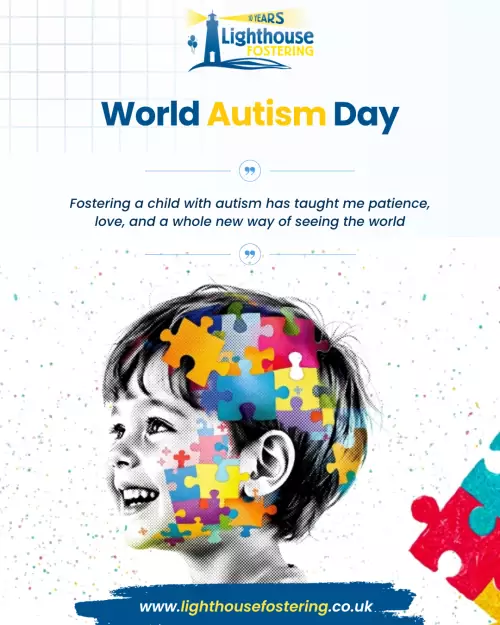
Every April, communities across the globe come together to mark World Autism Day. It is a vital opportunity to champion awareness, promote genuine acceptance, and build a society that truly supports autistic individuals. For those of us working in social care, this day carries a profound significance.
Children in the foster care system already face significant challenges, and for those who are autistic, navigating these changes requires highly specialised, deeply compassionate care. At Lighthouse Fostering, we believe that every child deserves a home where their unique view of the world is not just accommodated, but celebrated.
In this post, we explore the realities of caring for an autistic child, share an incredibly moving story from one of our own foster families, and detail the extensive fostering support we provide to ensure every child can thrive.
The Importance of Autism Awareness in Foster Care
Understanding autism is the first step towards creating a truly inclusive environment. Autism is a lifelong developmental disability that affects how people communicate and interact with the world. It is a spectrum condition, meaning it affects different people in different ways. Some autistic individuals require minimal support, while others need significant daily assistance.
For a child entering foster care, the experience is inherently unsettling. When that child is also autistic, the sudden change in environment, routine, and caregivers can be deeply overwhelming. The sensory input of a new house, the unfamiliar communication styles of new adults, and the loss of predictable routines can cause immense anxiety.
This is precisely why autism awareness is so critical for foster carers. A carer who understands autism can look past a child's distress and identify the unmet need beneath it. They can adapt their home, their communication, and their expectations to create a safe harbour for a child whose world has been turned upside down.
A Fostering Journey: Embracing Routine and Joy
To truly understand what it means to foster an autistic child, we only need to look at the lived experiences of our dedicated carers. Their daily lives are a testament to patience, empathy, and the incredible power of unconditional love.
Recently, one of our amazing foster carers shared their deeply inspiring experience of caring for their foster son, who is autistic. Their heartfelt words perfectly capture the nuanced reality of this role, balancing the everyday challenges with moments of profound, breathtaking joy.
Reflecting on their journey, the carer told us:
"For us, autism means that our days revolve around routine and consistency. But it also means noticing and celebrating the progress he’s made, like hearing his first full sentence at age 5 and seeing his pure joy when doing what he loves. It’s a privilege to be part of that happiness."
This beautiful reflection highlights two crucial aspects of therapeutic parenting for an autistic child: the absolute necessity of structure, and the incredible reward of witnessing a child achieve their unique milestones.
The Power of Routine and Consistency
As our carer rightly noted, days often revolve around routine. For many autistic children, predictability is a fundamental requirement for feeling safe. An unexpected change in plans can feel catastrophic.
Foster carers who support autistic children become masters of structure. They use visual timetables, give plenty of notice before transitions, and create highly predictable daily rhythms. This consistency acts as an anchor, reducing the child's anxiety and allowing them the mental space to learn, play, and connect.
Celebrating Every Milestone
The traditional milestones of childhood often look different for an autistic child. As our carer shared, hearing a first full sentence at age five is a monumental achievement.
Fostering an autistic child teaches you to redefine success. You learn to celebrate the small victories that others might take for granted. A new food tried, a loud noise tolerated, or a moment of shared eye contact becomes a cause for immense celebration. Being present for these moments, and sharing in the child's pure joy, is indeed a profound privilege.
Understanding the Needs of Autistic Children in Care
To provide the best possible care, we must look closely at the specific needs of autistic children. The foster home must adapt to the child, rather than expecting the child to force themselves into a neurotypical mould.
Managing Sensory Differences
Many autistic people experience sensory processing differences. They might be over-sensitive or under-sensitive to sights, sounds, smells, tastes, and touch. A busy foster home can sometimes present a sensory overload.
Effective foster carers learn to identify a child's sensory triggers. This might mean dimming the lights, providing noise-cancelling headphones, removing clothing labels, or creating a quiet, low-stimulation "chill-out" zone in the house. By actively managing the sensory environment, carers can prevent distress and help the child remain regulated.
Tailoring Communication
Communication is another area where thoughtful adaptation is essential. Some autistic children are non-speaking, while others have extensive vocabularies but struggle with the social nuances of conversation.
Carers must learn to tune into the child's preferred communication style. This could involve using Makaton, picture exchange systems (PECS), or simply giving the child extra time to process spoken instructions. Clear, literal language is often best, avoiding sarcasm or complex metaphors that can cause confusion.
How Lighthouse Fostering Supports Carers
We know that caring for an autistic child requires a unique skill set and a tremendous amount of emotional energy. We never expect our carers to navigate this complex journey alone. At Lighthouse Fostering, we provide a comprehensive safety net of resources and guidance.
Dedicated Fostering Support
When you foster with us, you are assigned a dedicated Supervising Social Worker who understands the specific challenges of raising a neurodivergent child. They provide regular, tailored supervision and act as a strong advocate for your family.
Whether you need help securing the right Educational Health and Care Plan (EHCP) for your foster child, or you simply need a listening ear after a difficult afternoon, our team is always there. We also provide a 24/7 on-call service, ensuring you have access to professional advice at any hour of the day or night.
Specialist Training Programmes
Education is the key to confidence. We offer an extensive range of specialist training to ensure our carers feel fully equipped. Our training goes far beyond basic autism awareness.
We run detailed workshops on therapeutic parenting, managing sensory processing differences, and understanding the communication needs of autistic children. We also bring in clinical experts to help carers develop practical, personalised strategies that work for their specific family dynamic. Our goal is to empower you with the knowledge you need to help the child in your care reach their full potential.
Building a Community of Acceptance
World Autism Day reminds us that our work extends beyond the walls of the foster home. We are committed to building a broader community of acceptance. We encourage our carers to connect with one another, sharing their experiences, strategies, and successes.
Our local support groups provide a safe space where carers of neurodivergent children can find solidarity and understanding. These connections are invaluable, reminding every carer that they are part of a wider, highly supportive professional family.
When we foster genuine acceptance, we show autistic children that they do not need to mask who they are to be loved. We show them that their unique perspective is a valuable addition to our community.
Take the Next Step With Us
The story shared by our foster carer is a powerful reminder of the incredible impact a loving home can have. Providing a safe haven for an autistic child is a highly rewarding path, filled with unique joys and meaningful progress.
If you have a spare bedroom, a patient heart, and a willingness to learn, you could be the person who transforms a child's life. You do not need previous experience with autism to apply; we will provide all the specialist training and fostering support you need to succeed.
We invite you to learn more about the rewarding world of fostering. Visit the Lighthouse Fostering website today to read more inspiring stories, explore our training resources, and find out how you can join our supportive community. Together, we can create a brighter, more inclusive future for every child.